
Waking up to a mediocre, bitter cup of caffeine is a frustrating way to start a busy American morning. As specialty café culture continues to boom across the country, settling for whatever comes out of an outdated, uncleaned machine is no longer necessary. However, stepping into the world of modern brewing equipment can feel incredibly overwhelming.
Whether you are rushing out the door for a morning commute and need a lightning-fast single-serve option, or you want to spend your Sunday morning meticulously crafting a pour-over, the equipment you choose dictates your entire experience. In this comprehensive 2026 guide, we will break down the most popular types of coffee makers available today, helping you find the absolute perfect match for your lifestyle, budget, and flavor preferences.
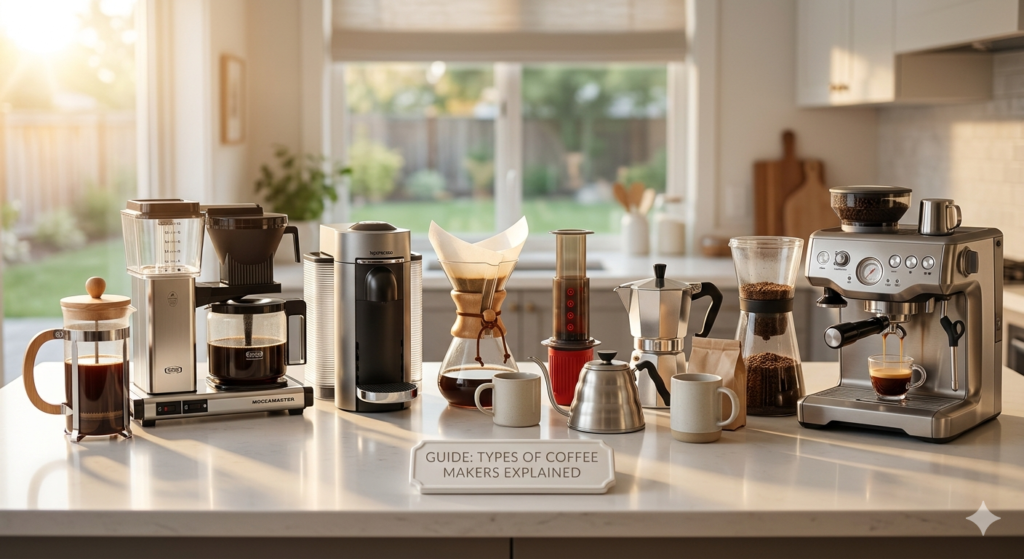
Key Takeaways (Article at a Glance)
- Two Main Categories: Brewing devices generally split into automatic systems (built for speed and daily consistency) and manual setups (built for absolute control and craftsmanship).
- Speed vs. Ritual: Drip machines and single-serve pod brewers dominate fast-paced mornings, while pour-overs and immersion presses cater to flavor purists.
- Extraction Methods Matter: How water interacts with your grounds—whether through percolation, immersion, or pressurized steam—drastically changes the body, acidity, and boldness of your final cup.
- The Grind Dictates the Gear: Purchasing the right brewer is only half the battle; pairing it with the correct grind size (from powder-fine to chunky and coarse) is essential for a balanced extraction.
Table of Contents
- The Automatic Heavyweights: Convenience & Consistency
- The Manual Masters: Crafting the Perfect Cup
- Specialty & Traditional Brewers: Global Classics
- Niche & Travel-Friendly Brewers
- Data Comparison: Finding Your Ideal Match
- Final Thoughts on Upgrading Your Morning
- FAQ
1. The Automatic Heavyweights: Convenience & Consistency
When you need high-volume output or zero-effort mornings, electric-powered automatic machines are the undeniable champions. They handle the heating, timing, and dispensing, leaving you to simply push a button.
The Classic Drip Coffee Maker
Walk into almost any household in the United States, and you will likely spot a standard drip machine sitting on the kitchen counter.
- How it Operates: You fill a back reservoir with cold water and place medium-ground coffee into a paper or metal filter basket. The machine heats the water to near-boiling temperatures and gently showers it over the grounds. Gravity pulls the extracted liquid down into a glass or thermal carafe.
- Who it is For: Families, office breakrooms, and anyone who wants to brew 10 to 12 cups at once with minimal effort. It delivers a familiar, balanced, and highly reliable cup. [External Link: Link to a study on American coffee consumption habits].
Single-Serve (Pod and Capsule) Systems
In recent years, single-serve machines from brands like Keurig and Nespresso have completely revolutionized morning routines.
- How it Operates: These utilize pre-packaged plastic or aluminum pods containing exact doses of grounds. Needles puncture the capsule, and pressurized hot water is forced through it, delivering a single mug in under sixty seconds.
- Who it is For: Busy professionals and households where everyone prefers a different roast or flavor profile. It is the ultimate mess-free solution, though environmental impact and cost-per-cup are higher than whole-bean methods.
Automated Espresso Machines
If you want café-quality lattes without the steep learning curve of commercial equipment, automation is key.
- Semi-Automatic: The machine regulates the water pressure (typically 9 bars) and temperature (around 195°F to 205°F). However, the user must still grind the beans, tamp the puck, and manually stop the shot. It is a great bridge between hobbyist control and daily consistency.
- Super-Automatic (Bean-to-Cup): These are literal countertop robots. With integrated burr grinders, automated milk frothers, and touchscreen displays, they handle every single step. In 2026, many of these connect to smartphone apps, allowing you to trigger a brew from your bed.
Grind & Brew Hybrids
A fantastic middle-ground for drip lovers who want peak freshness. These machines feature a built-in hopper and grinder. You load whole beans, and the machine grinds them directly into the filter basket mere seconds before the brewing cycle begins, preserving delicate aromatic oils.
2. The Manual Masters: Crafting the Perfect Cup
For enthusiasts who view morning brewing as a relaxing ritual rather than a chore, manual brewers offer unparalleled control over every single variable.
The French Press (Immersion Brewing)
Elegant, deeply traditional, and highly cost-effective, the French Press is a staple for those who love bold, heavy-bodied flavors.
- How it Operates: This is an immersion method. You combine very coarse grounds and hot water inside a glass or stainless-steel beaker, allowing them to steep freely for roughly 4 to 5 minutes. Afterward, you slowly push down a metal mesh plunger, trapping the grounds at the bottom while leaving the rich, unfiltered liquid at the top.
- Who it is For: Drinkers who hate the thinness of paper-filtered coffee and prefer a robust, oily, and textured mouthfeel.
The Pour-Over (Chemex & V60)
The darling of the modern third-wave specialty coffee movement.
- How it Operates: Utilizing a cone-shaped apparatus lined with a thick paper filter, the brewer slowly and deliberately pours hot water over a bed of medium-coarse grounds. Utilizing a specialized gooseneck kettle is highly recommended to control the flow rate.
- Who it is For: Flavor chasers. Because the thick filters trap heavy oils and sediment, the resulting cup is incredibly crisp, bright, and clean—allowing the subtle fruity or floral notes of single-origin beans to shine brightly. [Internal Link: Link to your “Chemex vs V60 Comparison Guide”].
The Cold Brew Maker
Not to be confused with iced coffee (which is just hot coffee poured over ice), true cold brew is a chemical process of patience.
- How it Operates: Extremely coarse grounds are fully submerged in cold or room-temperature water and left to steep in the refrigerator for 12 to 24 hours. The mixture is then heavily filtered, leaving behind a potent concentrate.
- Who it is For: Because hot water never touches the beans, the bitter acidic compounds are never extracted. The result is a naturally sweet, low-acid beverage that is incredibly gentle on sensitive stomachs.
3. Specialty & Traditional Brewers: Global Classics
Coffee has a rich, global history, and many traditional devices are still widely celebrated today for their unique extraction styles.
The Moka Pot (Stovetop Espresso)
A staple in European kitchens, particularly in Italy, the Moka Pot is an iconic, octagonal metal brewer.
- How it Operates: Placed directly on a stove burner, water in the bottom chamber is brought to a boil. The resulting steam pressure forces the hot water upward through a tightly packed basket of fine grounds and into a top collecting chamber.
- Who it is For: Those who want an intense, heavy, and highly concentrated shot similar to espresso, without spending hundreds of dollars on a motorized pump machine. It is perfect for cutting through sweet milk or drinking straight.
The Syphon (Vacuum Pot)
Looking like a piece of equipment stolen from a high school chemistry lab, the syphon is a visual masterpiece.
- How it Operates: Utilizing an open flame (like an alcohol or butane burner), water in a lower glass bulb is heated until vapor pressure pushes it up a tube into an upper chamber containing the grounds. Once the heat is removed, a vacuum effect forcefully sucks the brewed liquid back down through a filter.
- Who it is For: Entertainers and “mad scientists” who want their morning routine to double as a spectacular visual performance. It yields an exceptionally clean, tea-like cup.
The Percolator
Before the automatic drip machine took over the world, the heavy metal percolator ruled supreme, and it remains a favorite among campers.
- How it Operates: Boiling water is continuously cycled up a central metal tube and repeatedly splashed over a basket of coarse grounds.
- Who it is For: Nostalgia seekers and outdoor enthusiasts. Be warned: because the liquid is constantly boiling, it is notoriously easy to over-extract and burn the coffee if you do not pull it off the heat source quickly enough.
Turkish Coffee (The Ibrik/Cezve)
One of the oldest preparation methods in the world, originating in the Middle East.
- How it Operates: You need coffee ground finer than powdered sugar. It is mixed directly with cold water (and often sugar and spices like cardamom) inside a small copper or brass pot. It is slowly heated until it aggressively foams up, then removed from the heat.
- Who it is For: Drinkers who want an incredibly dense, syrupy, and unfiltered experience. You drink this slowly, leaving the thick sludge at the bottom of the tiny cup.
4. Niche & Travel-Friendly Brewers
Innovation in the industry never stops, leading to highly engineered devices built for specific modern needs.
The AeroPress
Invented in 2004 by the creator of the Aerobie flying ring, this plastic cylinder has achieved cult status globally.
- How it Operates: Utilizing pneumatic air pressure, you steep medium-fine grounds in water for just a minute or two, then physically press a rubber-sealed plunger down, forcing the liquid through a micro-filter directly into your mug.
- Who it is For: Frequent travelers, backpackers, and experimenters. It is virtually indestructible, cleans up in five seconds, and brews a grit-free, remarkably smooth cup that can mimic everything from standard drip to an espresso-like concentrate.
The Clever Dripper
A brilliant hybrid that marries the best parts of the French Press and the Pour-Over.
- How it Operates: It looks like a standard pour-over cone, but it features a specialized stopper valve at the bottom. You pour in your water and let the coffee fully immerse and steep for several minutes. When you are ready, simply set the brewer on top of your coffee mug; the rim of the mug pushes the valve open, releasing the flawlessly filtered coffee.
The Vietnamese Phin
A slow-drip metal filter that requires patience and a sweet tooth.
- How it Operates: A metal cup with a perforated bottom sits over your glass. You add medium grounds, tamp them down with an internal metal disc, and pour in hot water. The liquid drips painfully slow into the cup below.
- Who it is For: Fans of traditional Vietnamese iced coffee, where the intense, dark brew drips directly over a thick layer of rich, sweetened condensed milk.
5. Data Comparison: Finding Your Ideal Match
To make your purchasing decision easier, we have compiled a quick-reference matrix of the most popular types of coffee makers discussed above.
| Brewing Equipment | Extraction Method | Flavor Profile & Body | Required Effort | Est. Brew Time | Best Suited For |
| Drip Machine | Automated Percolation | Balanced / Medium | Very Low | 5 – 10 Min | Busy families & offices |
| French Press | Full Immersion | Bold, Heavy & Oily | Low | 4 – 5 Min | Texture lovers |
| Pour-Over | Manual Percolation | Clean, Bright & Complex | High | 3 – 4 Min | Craft enthusiasts |
| AeroPress | Immersion + Pressure | Smooth & Versatile | Low | 2 Min | Travelers & solo drinkers |
| Moka Pot | Steam Pressure | Intense & Concentrated | Medium | 5 – 8 Min | Stovetop traditionalists |
| Cold Brew Maker | Cold Immersion | Sweet & Low-Acid | Low | 12 – 24 Hrs | Sensitive stomachs |
| Super-Automatic | Electronic Pump | Rich & Consistent | Zero | Under 1 Min | Premium convenience |
6. Final Thoughts on Upgrading Your Morning
Exploring the myriad types of coffee makers on the market is an exciting journey into culinary science. Whether you lean toward the rustic charm of a stovetop Moka pot, the high-tech precision of an automated espresso rig, or the analytical purity of a Chemex pour-over, the right choice ultimately depends on your daily routine.
Remember, even the most expensive machinery in the world will produce a terrible beverage if paired with stale, pre-ground supermarket beans. Invest in a high-quality burr grinder, buy fresh beans from local roasters, and match your grind size to your chosen brewer.
Over to you: Which of these brewing methods are you currently using to survive your mornings, and are you planning an equipment upgrade this year? Let us know in the comments below!
Frequently Asked Questions (FAQ)
1. Which coffee maker produces the strongest cup of coffee?
If you are looking for intensity, the Moka Pot or a Manual Espresso Machine are your best bets. These methods use pressure to extract a highly concentrated brew. For those who prefer a “bold” but large cup, the French Press is the winner because its immersion brewing and metal filter allow more oils and sediment into the mug, creating a heavier mouthfeel compared to paper-filtered methods.
Check best coffee maker in Amazon
2. Is a drip coffee maker better than a French Press?
It depends entirely on your taste and schedule. A Drip Machine is superior for convenience and serving large groups, as it automates the process and keeps the coffee warm. A French Press is better for those who prioritize flavor and texture; it offers more control over the brew but requires manual effort and a consistent coarse grind to avoid a muddy cup.
3. Does the type of coffee maker affect the caffeine content?
Yes, but indirectly. The brewing method affects caffeine based on extraction time and water-to-coffee ratio. For example, while a single shot of espresso is more concentrated, a 12oz mug of Drip coffee often contains more total caffeine because of the larger volume of water and longer contact time with the grounds. Cold brew also tends to be very high in caffeine because of its long (12–24 hour) steeping process.
4. Why does my pour-over coffee taste better than my automatic drip?
Pour-over coffee often tastes “cleaner” because it uses thicker paper filters that remove almost all oils and fine particles. Additionally, manual pouring allows for a more even saturation of the grounds. Most cheap automatic drip machines don’t reach the optimal brewing temperature (195°F–205°F), which can lead to under-extraction and a flat or sour taste.
5. How often should I clean my coffee maker?
For daily users, you should perform a basic rinse after every use. However, a deep “descaling” (removing mineral buildup) is recommended every 3 to 6 months depending on your water hardness. If you use a machine with an integrated grinder, cleaning the burrs once a month is essential to prevent old, rancid oils from ruining the flavor of your fresh beans.