
You expect your coffee maker to work without thinking about it. That’s the whole point. So when it suddenly stops brewing—or starts giving you weak, inconsistent coffee—it feels like something serious has gone wrong. If your coffee maker is not brewing, you’re dealing with a very common issue. In most cases, the machine isn’t actually broken. Instead, small problems build up over time—things like mineral deposits, coffee maker setup, or simple maintenance gaps.
From real hands-on troubleshooting and working with different coffee setups, I’ve seen that most of these issues follow predictable patterns. Once you understand those patterns, fixing the machine becomes much easier—and much faster.
Check best coffee maker in Amazon
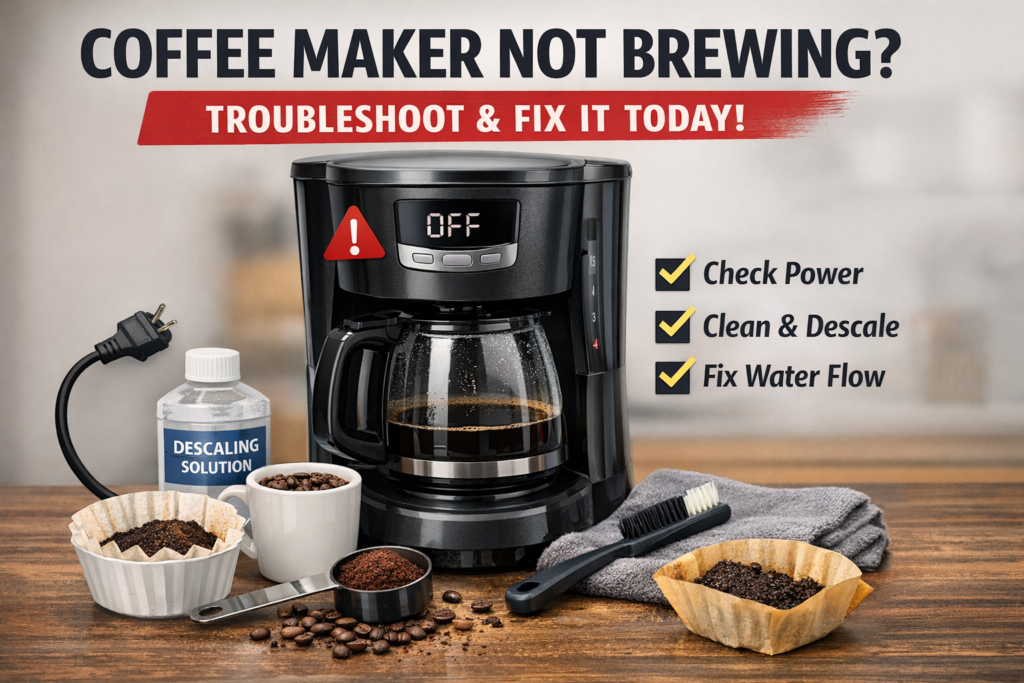
Coffee Maker Not Turning On
When your coffee maker doesn’t respond at all, it’s easy to think the machine has failed completely. But in reality, this is often the simplest problem to fix.
In many cases, the issue is related to power or setup rather than internal damage. A loose plug, a faulty outlet, or even a slightly misaligned water reservoir can stop the machine from starting.
To fix this properly, go step by step:
- First, confirm the machine is plugged in securely and the outlet is working
- Try a different outlet to rule out electrical issues
- Check if any indicator lights turn on or flicker
- Remove the water reservoir and place it back carefully
- Turn the machine off for a minute, then restart it
These checks may seem basic, but they solve a large percentage of “dead machine” cases without any further action.
Coffee Maker Not Brewing Due to Mineral Buildup
If your machine has power but still refuses to brew, the issue is often hidden inside the system.
Over time, minerals from water—especially hard water—build up inside the internal tubes and heating elements. This buildup restricts water movement and can eventually block it completely.
What makes this tricky is that the machine may look perfectly fine from the outside while struggling internally.
To fix this, you need to descale the machine properly:
- Fill the water reservoir with a descaling solution or a vinegar-water mix
- Run a full brew cycle so the solution moves through the system
- After that, run 1–2 cycles with clean water to remove any residue
In real-world use, machines that seemed completely non-functional often return to normal immediately after this process.
Coffee Maker Brewing Slowly or Producing Less Coffee
When your coffee maker still works but brewing slowly or coffee found less, it usually early warning sign.
This usually happens when mineral buildup has not fully blocked the system yet but has started to restrict water flow.
As a result, water moves more slowly through the machine, and the final output becomes inconsistent.
To fix this issue:
- Run a full descaling cycle as soon as possible
- Remove and clean the spray head or shower screen, where residue often collects
- Check the water intake area to make sure it’s not partially blocked
- Run a hot water cycle to clear any trapped air inside the system
Once these steps are completed, most machines regain their normal speed and output.
Coffee Tastes Weak or Watery
If your machine is brewing but the coffee tastes weak, the issue is usually not mechanical—it’s related to how the coffee is prepared.
Many users underestimate how sensitive coffee brewing is to small changes. Even slight differences in ratio or grind size can significantly affect the result.
To improve the strength and flavor:
- Start with a balanced coffee-to-water ratio (around 1–2 tablespoons per 6 oz, then adjust to taste)
- Make sure the grind size matches your machine type
- Use fresh coffee instead of older grounds that have lost flavor
- Clean your machine regularly, as buildup can weaken extraction
These changes may seem small, but together they create a noticeable improvement in taste.
Coffee Extraction Is Uneven or Tastes Off
If your coffee sometimes tastes sour and other times bitter, the issue is usually uneven extraction. This is one of the most common problems behind inconsistent coffee quality, especially in home brewing.
Uneven extraction happens when water does not flow evenly through the coffee grounds. Some parts of the coffee bed get too much water and become over-extracted, which creates a bitter, harsh taste. At the same time, other areas receive too little water and remain under-extracted, resulting in a sour or weak flavor. When both happen in the same brew, the final cup tastes unbalanced and unpredictable.
In most cases, this problem is not caused by the machine itself. It’s usually related to how the coffee grounds are prepared before brewing.
To fix this:
- Distribute the coffee grounds evenly in the filter or portafilter before starting the brew cycle. An uneven surface can cause water to channel through one side instead of flowing evenly.
- Break up any clumps in the coffee. Clumps block water flow and force water to move around them, which leads to poor extraction.
- If you’re using an espresso machine, apply consistent and level pressure while tamping. Uneven tamping creates weak spots where water flows too quickly.
- Make sure your machine is operating within a proper temperature range. Water that is too hot or too cool can make extraction even more inconsistent.
Once water flows evenly through the coffee bed, extraction becomes balanced. The result is a smoother, more stable flavor where you can clearly taste the coffee instead of random sour or bitter notes.
Coffee Maker Not Pumping Water Properly
If your coffee maker sounds like it’s running but water isn’t flowing properly, it’s usually a pressure issue rather than a complete failure.
In many cases, this happens because air gets trapped inside the system or mineral buildup partially blocks the internal pathways—not because the pump itself is broken.
To fix the problem:
- Run the hot water function to push out any trapped air
- Prime the machine if your model supports it
- Follow up with a full descaling cycle to clear internal buildup
This combination often restores normal pressure and water flow without the need for repairs.
Coffee Maker Has Internal Blockage from Residue
Even if your machine looks clean from the outside, internal residue can still cause problems.
Coffee oils and fine particles accumulate over time. These can stick to internal surfaces and reduce water flow, while also affecting taste.
To prevent and fix this:
- Clean removable parts like the filter basket and carafe every week
- Perform a deeper cleaning at least once a month
- Use warm water and a soft brush to remove stubborn residue
Regular cleaning keeps both performance and flavor consistent over time.
Coffee Taste Changed Suddenly
If your coffee was fine one day and suddenly tastes different the next, the cause is usually a small change that went unnoticed.
This could be:
- switching to a different type of coffee
- a slight change in grind size
- buildup inside the machine
- temperature variation
To fix it:
- go back to fresh, known coffee
- recheck your grind settings
- clean and descale the machine
Once you identify the change, the solution usually becomes obvious.
Coffee Maker Needs Cleaning and Maintenance
Many brewing issues don’t come from a single failure—they develop gradually due to lack of maintenance.
Machines collect mineral deposits and residue over time, which slowly reduces performance.
A simple routine helps prevent this:
- Clean removable parts every week
- Descale the machine regularly based on usage
- Double-check setup before each brew
This routine not only prevents problems but also improves coffee quality consistently.
Coffee Maker Not Brewing Before Replacement Check
Before deciding to replace your coffee maker, it’s important to go through a proper checklist.
Many machines are replaced unnecessarily when the issue could have been fixed easily.
Check the following:
- Is the power connection stable?
- Is the water reservoir properly placed?
- Has the machine been descaled recently?
- Are you using the correct grind size and fresh coffee?
In most cases, one of these factors is the real cause of the problem.
Final Thoughts
A coffee maker not brewing can feel like a major issue, but it’s rarely a permanent one.
From real-world experience, most problems come down to maintenance, setup, or small details that are easy to miss. Once you address those, the machine usually works just fine again.
Understanding how your coffee maker functions—and maintaining it properly—makes a big difference not just in performance, but also in the quality of your coffee.
FAQ
Why is my coffee maker not brewing at all?
It is usually caused by power issues, incorrect setup, or internal mineral buildup blocking water flow.
How often should I descale my coffee maker?
Every 1–2 months, depending on usage and water hardness.
Why does my coffee taste weak?
It is often due to incorrect ratio, grind size, or stale coffee.
Can a clogged coffee maker be fixed?
Yes, most clogs can be removed through proper descaling and cleaning.
Should I replace my coffee maker?
Not immediately. Most issues can be fixed with basic troubleshooting and regular maintenance.